
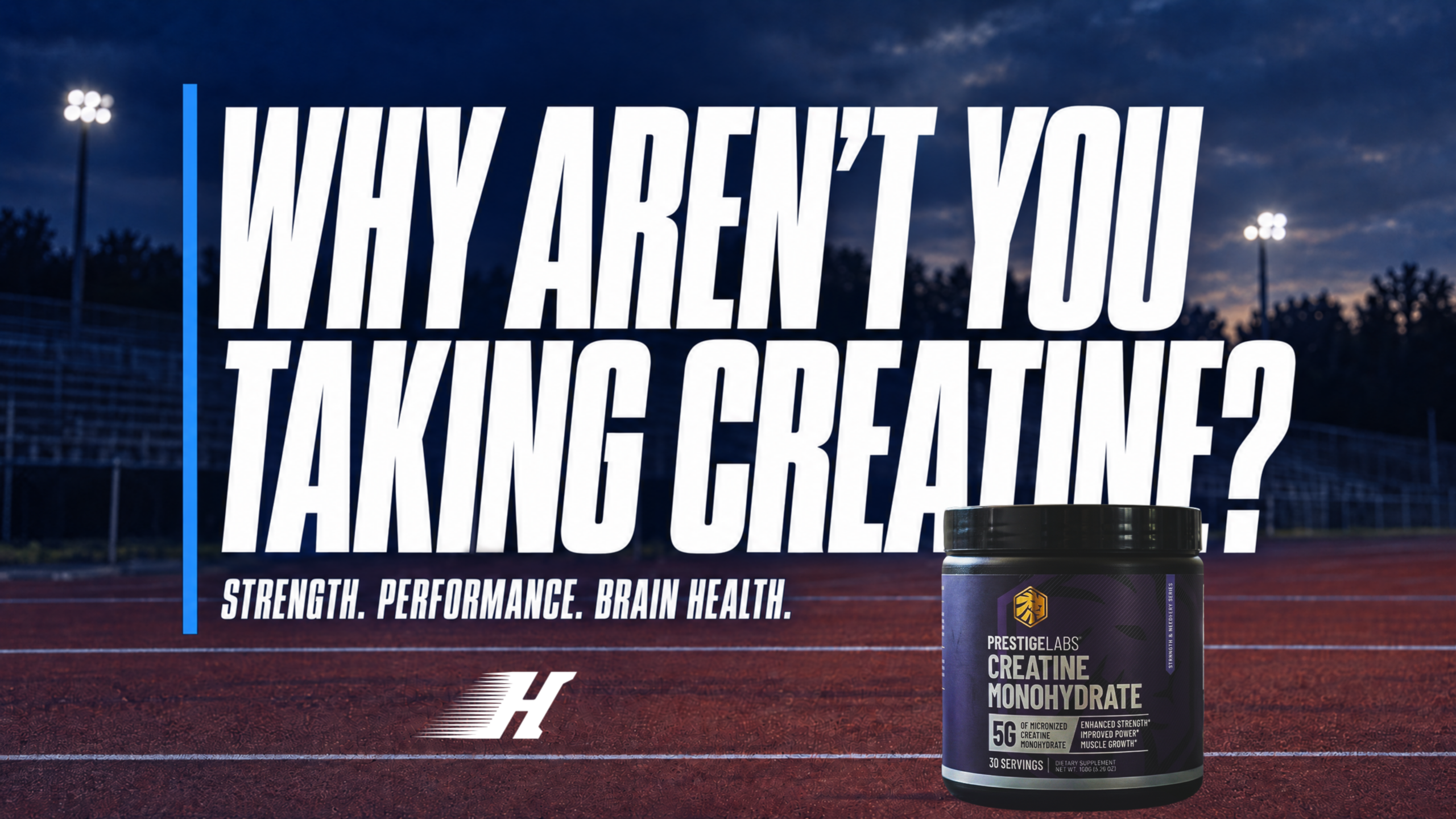
Creatine has a reputation as a supplement for people who want bigger muscles. That reputation leaves out a lot.
Your body makes creatine naturally. You also get it from foods like meat and fish. Your muscles use it when you sprint, jump, lift, or throw. Your brain uses it as part of its energy system, too. 1 2
You don’t have to be a bodybuilder to care about any of that.
Maybe you want to feel stronger in the weight room. Maybe you’re looking for ways to support your training. Or maybe you’ve seen headlines about creatine and brain health and want to know whether the research is worth your attention.
Let’s break down what creatine does, where it may help, and what the research has yet to prove.
What Does Creatine Actually Do?
Your body needs energy every time you move. Creatine helps your muscles quickly replenish a molecule called ATP, which your cells use for energy. 1
That matters most during short, demanding efforts. Think about driving out of the blocks, throwing a shot put, or finishing a difficult set of squats. Your muscles need energy fast.
Most of the creatine in your body is stored in your muscles. Taking creatine monohydrate can increase those stores, which may help during repeated, high-intensity efforts. 1
It won’t teach you how to sprint or throw. It won’t make up for skipping meals or cutting your sleep short. But when your training and recovery are in place, it may give you another way to support your work.
Creatine and Performance Enhancement
Performance enhancement can mean different things depending on your goal. You might want to build strength, produce more power, or maintain the quality of your training across repeated efforts.
Creatine has the strongest evidence for activities like these:
• Weight training.
• Repeated short sprints.
• High-intensity efforts with rest between them.
• Training that calls for short bursts of power.
Say you’re working on your acceleration. Your coach has you run several short sprints with rest between each one. Creatine may help support repeated high-intensity work, but it won’t fix your starting mechanics. You still need to practice those. 1
The same applies in the weight room. Creatine may help support strength gains alongside a consistent program. It doesn’t replace good lifting technique or a plan that progresses over time.
A 2024 review looked at 23 resistance-training studies involving people ages 18 to 49. Participants who took creatine while training gained more upper- and lower-body strength on average than participants who trained while taking a placebo. Most participants in those studies were men, so more research including women would help clarify the results. 3
Does that mean creatine guarantees a personal best? No. It means the supplement may help support the training that gives you a chance to improve.
What About Distance Running?
If you run the mile, the 5K, or cross-country, creatine is not likely to be your first tool for improving endurance. Its clearest performance benefits are tied to short, intense efforts rather than continuous aerobic exercise. 1 4
You might still have strength work, hill sprints, or other short efforts in your plan. Creatine could be worth discussing in that context. Just don’t confuse a possible benefit in the weight room with proof that it will make you faster over a long race.
Some people also gain weight from water stored in their muscles after taking creatine. Depending on your event and goals, that may be something to consider. 1
Creatine Benefits Beyond the Track and Weight Room
Strength is useful whether you’re chasing a faster time or trying to carry groceries without making two trips.
A 2026 review looked at 11 trials involving people age 60 and older. Those who took creatine while following a resistance-training program showed a small additional improvement in strength compared with people who trained without creatine or took a placebo. 5
The review did not find a clear additional benefit for muscle mass or physical function. In other words, it did not prove that creatine makes daily tasks easier or prevents falls. But the strength findings suggest it may be worth discussing as part of a training plan.
What does that look like in practice? Start with a program that fits your current ability. Learn the movements. Give yourself time to recover. Then consider whether a supplement makes sense for the goal you’re working toward.
Our personal training program gives you a place to start if you want help building strength and improving how you move.
Can Creatine Help Your Brain?
This is where the research gets interesting.
Your brain needs energy to handle everything from remembering information to reacting to what happens around you. Researchers are studying whether creatine can support some of those processes. 2
In 2024, researchers reviewed 16 randomized trials involving 492 people age 18 and older. Some participants were healthy, and others had health conditions. Across the studies, creatine was linked to a small improvement in memory test results. 2
The researchers also found possible improvements in attention time and processing speed. The evidence for those results was less certain. They did not find a significant improvement in overall cognitive function or executive function, which includes skills like planning and decision-making. 2
That’s a useful distinction. A supplement that helps on a memory test in some studies has not necessarily been shown to improve every part of how your brain works.
There is also research on creatine and sleep loss.
In a 2026 study, 29 healthy participants between ages 20 and 40 completed thinking and reaction-time tests during 21 hours without sleep. Creatine reduced the drop in performance on some of the tests compared with a placebo. 6
The study was small and used a single dose larger than a typical daily serving. It doesn’t tell us that a regular serving will produce the same result. It also doesn’t mean you can take creatine, skip sleep, and expect to perform normally.
For now, the most honest answer is that creatine may help with certain thinking tasks, but we need more research. It has not been proven to prevent dementia or treat a concussion or other brain disease. 2
Who Might Want to Learn More About Creatine?
Creatine may be worth discussing if you:
• Want to build strength through a consistent training program.
• Train for sprinting, jumping, throwing, or other power-based events.
• Want to support strength as part of your overall health routine.
• Eat little or no meat or fish and want to understand how creatine fits into your diet.
• Are interested in the research on memory and brain energy.
People who eat a vegetarian diet tend to have lower muscle creatine stores because they get less creatine from food. That doesn’t mean a supplement is necessary for everyone who avoids meat, and it doesn’t guarantee a change in brain function. 1
Before buying anything, ask yourself what you’re hoping to improve. Then look at the rest of your routine. Are you eating enough? Are you training consistently? Are you recovering between hard sessions?
Those answers matter more than what’s in a supplement container.
What Type of Creatine Should You Choose?
Creatine monohydrate is the form used in most of the research. Other forms often come with bigger claims and higher prices, but the Australian Institute of Sport says the evidence does not give a clear reason to choose them over monohydrate. 1
A plain, single-ingredient product also makes it easier to see what you’re taking.
You may hear people talk about a loading phase, where they take larger amounts for a short period before moving to a lower amount. Loading can raise muscle creatine stores faster, but it isn’t the only approach. 1
Talk with a healthcare professional or registered dietitian about whether creatine makes sense for you and what amount would be appropriate. Your health history, training, diet, and goals all belong in that conversation.
You don’t need to add a handful of other powders to make a training plan work. Start with the basics and make decisions one at a time.
Is Creatine Safe?
Research on creatine monohydrate is generally reassuring, though it does not answer every question for every person. 1
Some people notice stomach discomfort or an increase in body weight from water held in their muscles. Taking creatine with food and avoiding a high-dose loading phase may help with stomach discomfort. 1
If you have a health condition or take medications, talk with your healthcare professional before starting a supplement. The same goes if you’re pregnant or breastfeeding.
It’s also a good idea to tell your healthcare professional if you take creatine before getting blood work. A 2026 review found that creatine can raise blood creatinine, a marker used in common kidney tests. That change can affect how the results are interpreted and does not automatically mean kidney injury. 7
Is Creatine Banned in Sports?
Creatine itself is not prohibited in sport, according to the U.S. Anti-Doping Agency. 8
That doesn’t mean every product labeled as creatine is free from risk. Supplements can contain substances that aren’t listed on the label, including ingredients prohibited in competition.
If you compete and choose to use a supplement, look for third-party testing for banned substances. USADA identifies NSF Certified for Sport as a way to reduce that risk. Testing helps, but it cannot guarantee a product is risk-free. 9
The Habits That Matter Most
Creatine can be part of a conversation about strength, performance, and health. It shouldn’t be the entire conversation.
Look at what your week actually includes:
• Are you eating regular meals that support your activity?
• Are you getting carbohydrates and protein around demanding training days?
• Do you have a plan for strength, technique, and recovery?
• Are you sleeping enough to show up ready for your next session?
A sprinter can take creatine and still need work on acceleration. A thrower can take it and still need to practice footwork. A person who wants to get stronger still needs a program they can follow.
That’s where coaching comes in. Supplements may support the work, but the work still has to happen.
If you want help building a training plan, contact a Hustle Denver trainer to get started. You can also learn about event-specific coaching and apply to join Hustle Track Club.
References
• Australian Institute of Sport: Creatine guidance
• Xu and colleagues, 2024: Creatine and cognitive function meta-analysis
• Wang and colleagues, 2024: Creatine and resistance-training strength gains
• National Institutes of Health: Supplements for exercise and athletic performance
• Yao and colleagues, 2026: Creatine and resistance training
• Gordji-Nejad and colleagues, 2026: Creatine and cognition during sleep deprivation
• De Souza Almeida and colleagues, 2026: Creatine and kidney health meta-analysis
• U.S. Anti-Doping Agency: What athletes need to know about creatine